

Background
For a number of years, RES has been exploring the potential for a wind farm at Cairnmore Hill, approximately 4.5 km west of Thurso.
Cairnmore Hill offers excellent potential for a wind farm development. It has good wind resource, few ecological constraints, straight-forward access off the A836 public road and is close to Scrabster harbour for turbine deliveries. Importantly, it also lies in an area identified by Highland Council as having ‘potential for wind farm development’ and within an area that the Caithness and Sutherland Local Development Plan seeks to promote as an internationally renowned centre for renewable energy and area for energy business expansion. It also lies outwith any nature conservation, landscape or cultural designations.
We have undertaken extensive survey work and environmental studies in order to build a thorough understanding of the site and a wealth of data has been gathered, providing a rigorous dataset to help develop the design. This information, together with feedback from the local community and key consultees, has played an important part in the design development process over the years.
A 10-turbine scheme was originally developed and then later reduced to 8-turbines. The project received positive feedback from the public at the 2016 and 2019 public exhibition events held in Forss and Thurso. However, in March 2021, the scheme was refused by The Highland Council.
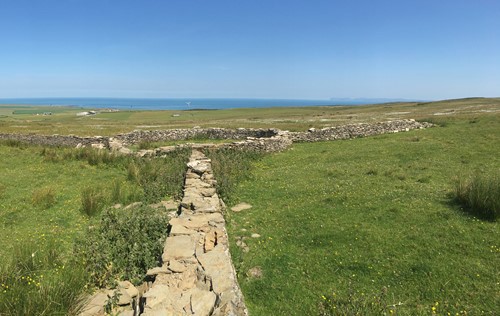
Sheepfold on Cairnmore Hill site
Redesigning the proposal
This revised scheme was capable of generating clean, low cost renewable electricity for around 28,000 homes and offsetting approximately 23,736 tonnes of carbon emissions compared to the use of fossil fuels. It also included measures to enrich key habitats across the site and achieve a 16% biodiversity net gain. In addition, it was predicted to deliver around £1.4 million of inward investment to the local area and £8.75 million in business rates to the Council - in addition to a tailored community benefit package for the local area.